

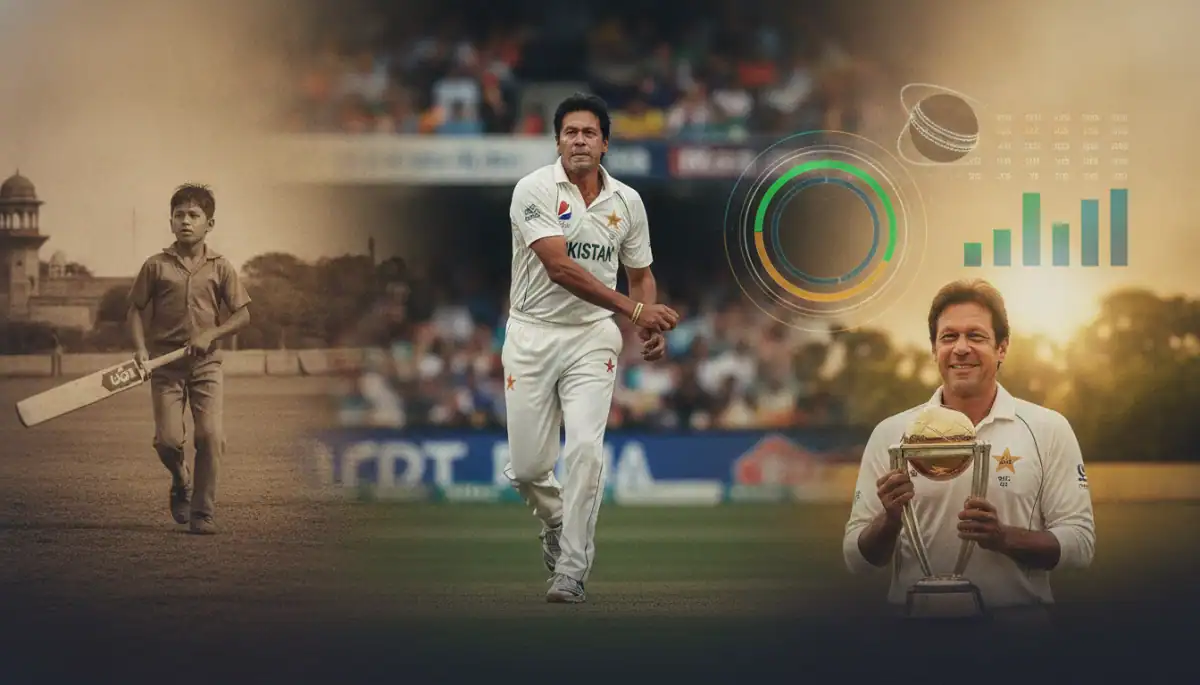
How Imran Khan’s upbringing and education shaped a future cricketing icon
I approach Imran Khan’s biography by tracing the early influences that molded both the cricketer and the leader. Born in Lahore in 1952, Imran’s childhood combined the privileges of a well-connected family with the drive of an ambitious athlete. I find it important to show how his formative years — family background, schooling, and time abroad — created the platform for his distinct playing style and leadership qualities.
From an early age, Imran balanced academic expectations with a growing passion for sport. His exposure to competitive cricket at local schools and clubs introduced him to fast bowling and all-round play long before international selection arrived. Understanding these roots helps explain why he later emphasized discipline, fitness, and a strategic approach to Test and One-Day cricket.
Family, schooling, and the move to England
I describe Imran’s family as supportive but demanding: a household that valued education and public service. He attended Aitchison College in Lahore, where I note his athletic talents first came to the fore. Aitchison provided a structured environment that allowed him to refine physical skills alongside academic pursuits.
At age 18, Imran moved to England for higher education at Keble College, Oxford. This transition was pivotal. I saw two immediate effects: exposure to a higher level of club and university cricket, and a maturation of his cricketing intellect. Playing for Oxford University and in English county matches taught him how to adapt to different pitches and conditions — an education that served him throughout his international career.
- Early schooling: Aitchison College — development of foundational athletic skills.
- University cricket: Keble College, Oxford — tactical growth and exposure to seam-friendly conditions.
- County experience: Matches in England that honed pace, rhythm, and endurance.
Early cricket milestones and the formation of a fast-bowling all-rounder
I trace Imran’s first-class debut and rapid progression into the Pakistani national side. His early Test selection in the early 1970s came after notable performances in university and county cricket. I emphasize the gradual but decisive evolution of his bowling action — a mix of pace, bounce, and the ability to reverse-swing the older ball — which would later define his greatness.
During these initial years, I highlight several standout moments: maiden Test wickets, the first five-wicket hauls, and early contributions with the bat that hinted at his emerging all-round capability. I also point out how contemporaries and coaches began to recognize his leadership potential, a trait that later culminated in captaincy and political prominence.
- First-class breakthroughs: key matches that secured national selectors’ attention.
- Bowling development: emphasis on fitness, rhythm, and late movement.
- Batting contributions: lower-order resilience that added balance to the team.
Having established these early foundations, I will next examine Imran Khan’s ascent into international stardom, his captaincy era, and the statistical achievements that cemented his legacy.
Ascent to international stardom: defining performances and growing reputation
From the mid-1970s onward I chart Imran Khan’s transformation from a promising seam-bowler to an international star. What I emphasize is not a single overnight breakout but a string of performances that gradually made him indispensable to Pakistan. I saw him repeatedly turn matches with a mix of pace, unpredictable bounce and, increasingly, reverse swing — skills that made him a handful in both home and away conditions.
Key tours and Tests across the late 1970s and early 1980s built his reputation. Time and again he produced match-turning spells, claiming crucial wickets and producing lower-order innings that rescued Pakistan from precarious positions. It was this dual value — a strike bowler who could also grind out runs — that elevated him above many of his contemporaries. Selectors and pundits began to refer to him as the fulcrum of Pakistan’s side: the player around whom a winning game-plan could be constructed.
Importantly, Imran’s performances were not just about raw speed. I note how he learned to use intelligence and game management: setting fields that encouraged batsmen into mistakes, alternating aggression with accuracy, and pacing himself across long Test matches. These qualities made him a natural leader even before he formally took up the captaincy.
Captaincy era: rebuilding a team and the road to 1992
When Imran assumed—and later reclaimed—Pakistan’s captaincy, I observe a deliberate shift in team culture. He insisted on fitness, unity and a fearless brand of cricket. My narrative highlights how he experimented with personnel, backed young fast bowlers and prioritized a balanced side capable of competing in all conditions.
Perhaps the single most defining chapter of his captaincy was the 1992 World Cup. I write about how he moulded a ragged, undervalued Pakistan into champions through shrewd leadership, tactical flexibility and the ability to galvanize players at critical moments. That campaign, for me, epitomizes his capacity to convert potential into performance — coaxing bowlers to attack at the right time, instilling belief in inexperienced batsmen, and making tactical calls that turned tight matches in Pakistan’s favor.
Beyond trophies, I stress the longer-term impact of his captaincy. Imran’s willingness to mentor and trust raw pace talent helped create Pakistan’s fearsome fast-bowling tradition. By nurturing bowlers who would go on to dominate world cricket, he left a legacy that extended far beyond his own playing days.
Statistical footprint: records, milestones and lasting measures of greatness
Numbers alone cannot capture leadership or clutch performance, but they reinforce why I regard Imran as one of cricket’s great all-rounders. Across a long international career he amassed well over 300 Test wickets and scored in excess of 3,000 Test runs — figures that place him among the most influential players of his generation. In One-Day internationals he was a constant match-winner across more than 150 appearances, producing both vital spells with the ball and key knocks with the bat.
What I find most revealing in the statistics are the context-sensitive numbers: multiple five-wicket hauls in Tests, crucial late-order partnerships, and performances in marquee matches that swung series or tournaments. These data points, combined with the intangible — leadership, resilience and the ability to extract the best from teammates — are what, in my view, cement his place in cricketing history.
Life after cricket: philanthropy and public life
Beyond the boundary ropes, Imran Khan translated the discipline and public profile he built in cricket into large-scale social projects and a controversial political career. He spearheaded the creation of major philanthropic institutions — most notably a cancer hospital and medical research centre — and later founded a political movement that culminated in national leadership. His post-cricket years have been marked by the same intensity and polarizing public attention that followed his on-field exploits. For readers seeking a concise record of his playing career and statistics, see Imran Khan on ESPNcricinfo.
Imran Khan’s enduring legacy
Imran Khan’s life resists a tidy label: sportsman, philanthropist, political figure — each role informs the others. What endures most clearly is not a set of scorecards but a pattern of ambition and public-facing leadership. His approach to building teams, confronting challenges and pursuing goals left recognizable traces in Pakistan cricket and in the institutions he helped create. Regardless of how history judges his political chapter, the values he championed in sport — commitment, resilience and a willingness to shoulder responsibility — continue to shape how many remember him.
- Influence on cricket culture: a professional ethos and a generation of fast-bowling talent.
- Lasting institutions: philanthropic and educational initiatives that outlive any single career.
- Model of public engagement: a sports figure who sought national impact beyond athletic success.